
Free Online Planning Poker with Anonymous Voting for Agile Teams
Estimate user stories with 7 methods — Fibonacci, T-Shirt, PERT, Dot Voting, Bucket System, Five Fingers and Decimal. Anonymous real-time voting with hidden cards, detailed statistics (mean, median, mode), consensus detection and unlimited stories per session. Import stories from Smart Todo, export to Agile Sprint backlog. Role-based permissions for Facilitator, Voter and Observer. Also known as Scrum Poker, Agile Poker or Team Estimation Game. Sign in with Google and start in seconds — completely free.
Start Estimating Free →See the Estimation Room in Action


How the Team Estimation Game Works
Create a Session and Add Stories
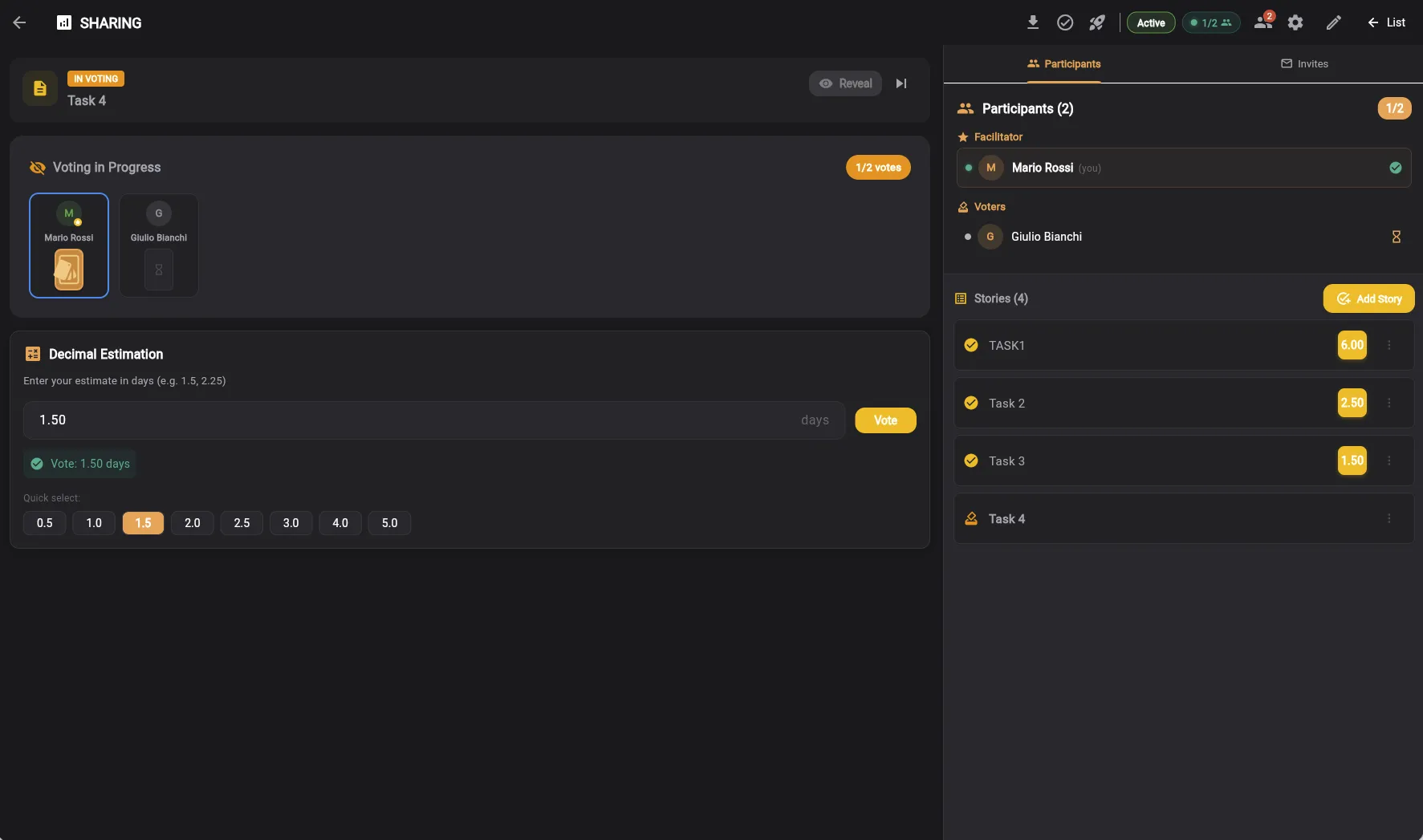
Choose from 7 estimation methods — Fibonacci, T-Shirt, PERT, Dot Voting, Bucket System, Five Fingers or Decimal. Add your user stories manually or import them directly from your Smart Todo lists. Invite your team with specific roles: Facilitator, Voter or Observer.

Vote Anonymously in Real Time
Team members vote simultaneously with hidden cards — no one sees others' estimates until the reveal. This prevents anchoring bias and ensures genuine assessments. Live presence tracking shows who has voted and who is still deciding. No limit on the number of stories you can estimate.
Review Statistics and Export
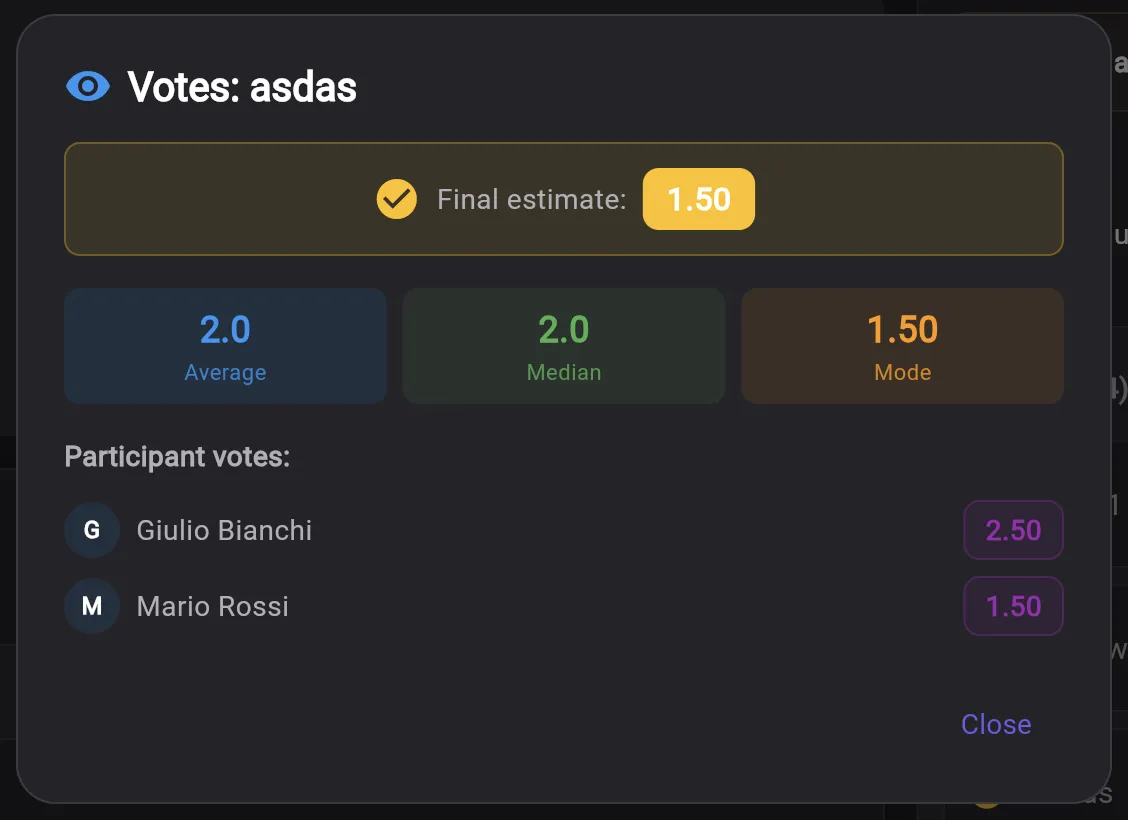
After reveal, review detailed statistics — average, median, mode, and each participant's individual vote. Set the final estimate and export results to a new or existing Agile Process sprint backlog. Story points and estimates carry over automatically for immediate sprint planning.
Why Agile Teams Choose Keisen for Planning Poker
7 Estimation Methods
Fibonacci, T-Shirt, PERT, Dot Voting, Bucket System, Five Fingers and Decimal — every method your team needs in one tool.
Anonymous Voting
Hidden cards prevent anchoring bias. No one sees others' votes until the facilitator triggers the reveal — ensuring genuine, independent estimates.
Detailed Statistics
Average, median, mode, standard deviation, vote distribution and each participant's individual vote. Full transparency after reveal.
Unlimited Stories
No caps on votable items. Estimate 5 stories for a quick Sprint Planning or 100+ for a full backlog session — no artificial limits.
Cross-Tool Integration
Import stories from Smart Todo lists. Export estimates to new or existing Agile Process sprint backlog with story points preserved.
Role-Based Permissions
Facilitator manages the session, Voters estimate, Observers watch without voting. Roles assigned via invite system with email invitations.
7 Estimation Methods for Every Agile Team
Fibonacci (Story Points)
The gold standard for agile estimation. The modified Fibonacci sequence 0, 1, 2, 3, 5, 8, 13, 20, 40, 100 plus ? (unsure) and ☕ (coffee break) cards. The increasing gaps reflect natural uncertainty in larger estimates — it's easier to distinguish a 3 from a 5 than a 23 from a 25. Used by most Scrum teams worldwide for relative complexity estimation.
Best for: Story point estimation, Sprint Planning, Backlog Refinement
T-Shirt Sizing Estimation
Quick relative sizing with XS, S, M, L, XL and XXL. Removes the pressure of assigning exact numbers and focuses purely on relative complexity. Teams compare stories: "Is this task closer to a Small or a Medium?" Perfect for initial backlog estimation, non-technical stakeholders, and teams new to agile estimation.
Best for: Quick sizing, high-level estimation, cross-functional teams
PERT Estimation (Three-Point)
Statistical estimation where each voter provides three values: Optimistic (best case), Most Likely (expected), and Pessimistic (worst case). The PERT formula (O + 4M + P) / 6 produces a weighted estimate. Keisen calculates standard deviation and variance to quantify risk. Essential for high-uncertainty items and PMI-compliant project forecasting.
Best for: Risk assessment, high-uncertainty items, project forecasting
Dot Voting Tool
Silent prioritization where each participant allocates a fixed number of points (1-10, default 5) across options. No discussion needed — votes reveal true team priorities without groupthink bias. Ideal for feature prioritization, roadmap planning, and democratic decision-making when the team needs to rank options quickly.
Best for: Prioritization, feature selection, democratic decision-making
Bucket System Estimation
Affinity-based estimation that groups items into complexity buckets: XS, S, M, L and XL. Teams sort stories by relative complexity rather than precise estimates — "This feels like a Large compared to that Small." Perfect for rapid estimation of large backlogs (50+ stories) where individual precision is less important than relative ordering.
Best for: Large backlog estimation, quick sorting, initial project scoping
Five Fingers Voting
Rapid 1-to-5 voting for quick team consensus. Based on the fist-to-five technique used in agile ceremonies: 1 = strong disagreement, 3 = neutral, 5 = full agreement. Simple, fast, and effective. Perfect for confidence checks ("Are we ready to commit to this sprint?"), quick polls during standups, and lightweight estimation rounds.
Best for: Confidence votes, quick polls, daily standups, rapid consensus
Decimal (Free Input)
Free-form decimal input for precise estimates like 1.5, 2.25 or 3.75 days. No predefined cards — each voter enters their own value with quick-select buttons (0.5, 1.0, 1.5, 2.0, 2.5, 3.0, 4.0, 5.0) for speed. Ideal for time-based estimation and effort tracking in hours or days when your team needs exact figures rather than relative sizing.
Best for: Time-based estimation, effort in hours/days, precise values
Complete Agile Estimation Toolkit
- 7 estimation methods covering every agile methodology — from Fibonacci story points to PERT risk analysis, T-Shirt sizing, Dot Voting, Bucket System, Five Fingers and free-form Decimal input
- Anonymous real-time voting — team members vote simultaneously with hidden cards to prevent anchoring bias. No one sees others' estimates until the facilitator triggers the collective reveal, ensuring each person's genuine assessment
- Unlimited stories per session — no artificial caps on the number of items you can estimate. Whether it's 5 stories for Sprint Planning or 100+ for a full backlog grooming session
- Detailed vote statistics — after reveal, view the final estimate, average (mean), median, mode (most frequent vote), standard deviation, vote distribution, and each participant's individual vote for full transparency
- PERT three-point estimation with aggregate variance analysis across all voters — quantify uncertainty and risk with Optimistic, Most Likely and Pessimistic values
- Role-based permissions — Facilitator (creates session, manages stories, controls reveal, sets final estimates), Voter (estimates stories), Observer (watches without voting — ideal for stakeholders). Roles assigned during the invitation process
- Cross-tool import — import stories directly from your Smart Todo lists to avoid re-entering task titles and descriptions. Seamless workflow integration
- Cross-tool export — export estimated stories with story points and final estimates to a new or existing Agile Process sprint backlog. Estimates carry over automatically for immediate sprint planning
- Invite system — share your estimation session via email invitations with role assignment. Team members join instantly with their assigned permissions
- Live presence tracking — see who is online, who has voted, and who is still deciding. Real-time participant heartbeat monitoring for distributed teams
- Auto-reveal — optionally enable automatic card reveal when all participants have voted, or keep manual facilitator control for structured sessions
- Automatic consensus detection — when all voters agree, the system celebrates and highlights the unanimous estimate
- Session lifecycle — manage sessions through Draft → Active → Completed states with full story history and vote records preserved
- Mobile compatible — fully responsive design works on smartphones, tablets and desktop browsers. Vote from any device, no app download needed
- Sign in with Google and start your first session in seconds — no lengthy registration forms, works in any browser
- A modern free alternative to PlanITPoker, Scrumpoker-online, PointingPoker and other planning poker tools — with more estimation methods and deeper statistics
Complete your agile workflow: prioritize with Eisenhower Matrix, manage tasks with Smart Todo, estimate with Planning Poker, plan sprints with Agile Process, and reflect with Retrospective Board.
What Is Planning Poker? Origin and Method
Planning Poker (also called Scrum Poker or Agile Poker) is a consensus-based estimation technique used by agile software development teams to estimate the effort or relative complexity of user stories and tasks.
The technique was first described by James Grenning in 2002 and later popularized by Mike Cohn in his influential book Agile Estimating and Planning (2005). The core idea is simple: each team member privately selects a card representing their estimate, then all cards are revealed simultaneously. This anonymous voting approach prevents anchoring bias — the tendency for team members to be influenced by the first estimate they hear, especially from senior colleagues.
The Fibonacci sequence (0, 1, 2, 3, 5, 8, 13, 20, 40, 100) is the most common scale because the increasing gaps between numbers reflect natural estimation uncertainty: it's easy to tell the difference between a 3-point and a 5-point story, but much harder between a 23 and a 25. This forces teams to think in terms of relative complexity rather than false precision.
Keisen brings Planning Poker into the digital age with 7 estimation methods beyond just Fibonacci, real-time anonymous voting for remote and co-located teams, detailed statistical analysis after each round, and seamless integration with task management and sprint planning tools.
Which Estimation Method Should You Choose?
With 7 methods available, picking the right technique depends entirely on your team's maturity and the type of items in your backlog. Here is a quick guide to selecting the perfect framework:
Fibonacci vs. T-Shirt Sizing
Use Fibonacci when estimating granular user stories for an upcoming Sprint. Numbers force the team to think critically about effort, risk, and complexity. Switch to T-Shirt Sizing during high-level backlog grooming or when stakeholders are present. T-Shirt sizes prevent non-technical members from falsely confusing story points with billable hours.
Standard Poker vs. Three-Point PERT
Standard Planning Poker is ideal for routine stories. But if your team frequently tackles high-risk infrastructure changes or legacy code refactoring, use PERT. By explicitly asking for "Pessimistic" and "Optimistic" bounds, PERT surfaces hidden technical debt and helps project managers quantify standard deviation and variance.
Dot Voting and the Bucket System
If you have a massive backlog of 50+ items, traditional Planning Poker will exhaust the team. Use the Bucket System to rapidly sort stories into relative complexity buckets, or use Dot Voting to democratically decide which Epics or features should be prioritized next, regardless of their estimated size.
The 5 Biggest Mistakes in Agile Estimation (And How to Fix Them)
Even experienced Scrum teams fall into predictable estimation traps. Here are the five most common anti-patterns that destroy agile velocity:
1. The Anchoring Bias (The "HiPPO" Effect)
If the Lead Developer or Highest Paid Person's Opinion (HiPPO) speaks first, junior members will subconsciously adjust their estimates to match. The Fix: Always use a tool like Keisen that enforces simultaneous, anonymous voting with hidden cards until the reveal.
2. Equating Story Points to Exact Hours
Story points measure relative complexity, effort, and risk—not time. An 8-point story means it's roughly twice as complex as a 4-point story. If you force points to equal exactly "1 point = 8 hours", you lose the psychological safety that makes relative estimation work.
3. Averaging the Divide
If three developers vote "3" and one developer votes "13", the answer is not to quickly agree on an "8" to save time. The Fix: Let the outliers explain their reasoning. The person who voted "13" might have spotted a critical database migration the rest of the team missed.
4. Estimating the "Un-Estimatable"
If the entire team throws the "100" or "?" card, the user story is too vague or too large (an Epic). The Fix: Stop the estimation. Break the story down into smaller, actionable pieces, or schedule a technical Spike to gather more information before the next Sprint Planning.
5. Punishing Teams for Inaccurate Estimates
Estimates are guesses based on current knowledge, not blood oaths or deadlines. If management uses story points as a weapon during performance reviews, developers will systematically pad their estimates, rendering your velocity metrics completely useless.
Best Practices for Remote Planning Poker Teams
Running an estimation session with a distributed team across multiple time zones presents unique challenges. Keisen addresses these natively, but facilitation matters.
First, maintain a strict Timebox. Allocate exactly 2-3 minutes of open discussion per story before initiating the vote. If consensus isn't reached after two voting rounds, park the story and move on to keep energy levels high.
Second, leverage Live Presence Tracking. In a remote meeting without webcams, it's hard to tell if someone is thinking or if they disconnected. A digital tool reveals who is actively "Voting" vs "Deciding", allowing the facilitator to gently prompt stalled members.
Finally, utilize the Cross-Tool Export. The biggest mistake remote teams make is losing the context generated during the meeting. When consensus is found, instantly export the estimated stories directly from the Estimation Room into your Agile Process Sprint Backlog to preserve the momentum.
Frequently Asked Questions
What estimation methods are available in Keisen?
Keisen Estimation Room offers 7 estimation methods: Fibonacci (classic story point sequence 0, 1, 2, 3, 5, 8, 13, 20, 40, 100 with ? and coffee break cards), T-Shirt Sizes (XS to XXL for quick relative sizing), Three-Point PERT (Optimistic + 4x Most Likely + Pessimistic / 6 with variance analysis), Dot Voting (silent point allocation for prioritization), Bucket System (affinity-based grouping by complexity), Five Fingers (rapid 1-5 voting for quick consensus), and Decimal (free-form input for precise estimates like 1.5 or 2.75 days).
Is the Planning Poker tool free?
Yes, Keisen Planning Poker and Estimation Room is completely free with no hidden limits. You can create estimation sessions, add unlimited stories, invite your entire team, vote in real-time and track detailed statistics for all 7 estimation methods. Sign in with Google and start estimating in seconds.
How does anonymous voting work?
All team members vote simultaneously with hidden cards — no one can see others' votes until the reveal. Each voter selects their estimate independently. Once everyone has voted, the facilitator reveals all cards at once (or auto-reveal can be enabled). The system then calculates statistics including mean, median, mode and consensus detection. This anonymous approach ensures genuine assessments without being influenced by senior team members or vocal participants.
What is Three-Point (PERT) estimation?
Three-Point PERT is a statistical estimation technique where each voter provides three values: Optimistic (best case), Most Likely (expected), and Pessimistic (worst case). The PERT formula (O + 4M + P) / 6 produces a weighted estimate that accounts for uncertainty. Keisen also calculates standard deviation and variance to quantify estimation risk. Ideal for high-uncertainty items and project forecasting.
Can I import stories from other Keisen tools?
Yes, Keisen offers full cross-tool integration. You can import stories directly from your Smart Todo lists into an estimation session — no need to re-enter task titles and descriptions. After estimation, you can export the results with story points and final estimates to a new or existing Agile Process sprint backlog. This creates a seamless workflow from task management to estimation to sprint planning.
Can I use Planning Poker with a remote team?
Yes, Keisen is designed for both remote and co-located teams. It works in any browser with no software to install. Team members can join via invite link, vote anonymously in real-time, and see results instantly. Live presence tracking shows who is online, who has voted, and who is still deciding — making it perfect for distributed agile teams across different time zones.
What statistics are shown after voting?
After votes are revealed, Keisen shows a detailed statistics panel for each story: the final estimate set by the facilitator, average (mean), median, mode (most frequent vote), and each participant's individual vote. For PERT estimation, it also shows aggregate PERT values, average standard deviation and total variance across all voters. You can review vote details for any story at any time.
How do roles and permissions work?
Keisen supports three roles with specific permissions: Facilitator (creates the session, manages stories, controls reveal timing, sets final estimates), Voter (participates in estimation rounds, votes on stories, views statistics), and Observer (watches the session and views results without voting — ideal for stakeholders and product owners). Roles are assigned during the invitation process via email.
Is there a limit on the number of stories?
No, there is no limit on the number of stories you can estimate in a single session. Add as many user stories as your team needs — whether it's 5 for a quick Sprint Planning or 100+ for a full backlog estimation. All stories are tracked with their voting history and final estimates.
Does the Estimation Room work on mobile devices?
Yes, Keisen Estimation Room is fully responsive and works on smartphones, tablets, and desktop browsers. Team members can vote, view statistics, and participate in estimation sessions from any device — no app download needed. The voting cards, statistics panels, and participant lists all adapt to your screen size.
How is Keisen different from PlanITPoker, Scrumpoker-online or PointingPoker?
Keisen offers 7 estimation methods (most tools only support Fibonacci), built-in PERT three-point estimation with variance analysis, Dot Voting and Bucket System for advanced prioritization, unlimited stories per session, role-based permissions (Facilitator, Voter, Observer), cross-tool integration with Smart Todo and Agile Process, real-time presence tracking, and detailed per-story statistics with individual vote history — all completely free with no registration walls.
What is Planning Poker and why do agile teams use it?
Planning Poker (also called Scrum Poker) is a consensus-based estimation technique where each team member privately selects a card representing their estimate. Cards are revealed simultaneously to avoid anchoring bias. If estimates differ significantly, the team discusses and re-votes until consensus. The technique was first described by James Grenning in 2002 and later popularized by Mike Cohn in Agile Estimating and Planning. Teams use it because anonymous, simultaneous voting produces more accurate estimates than open discussion.
What are story points and why use Fibonacci numbers?
Story points are a relative unit of measure used in agile to estimate the effort or complexity of user stories. The Fibonacci sequence (0, 1, 2, 3, 5, 8, 13, 20, 40, 100) is used because the increasing gaps between numbers reflect natural estimation uncertainty — it's easier to distinguish between a 3 and a 5 than between a 23 and a 25. This forces teams to think in terms of relative complexity rather than false precision. Keisen uses the modified Fibonacci sequence standard in agile, plus ? (unsure) and coffee break cards.
What is T-Shirt sizing estimation and when should I use it?
T-Shirt sizing is an agile estimation technique where teams categorize work items as XS, S, M, L, XL or XXL based on relative complexity. Unlike Fibonacci story points, T-Shirt sizes remove the pressure of assigning precise numbers — teams simply compare items ("Is this closer to a Small or a Medium?"). It's ideal for initial backlog grooming, roadmap planning with non-technical stakeholders, and teams new to agile estimation. In Keisen, T-Shirt sizing works with anonymous voting and automatic consensus detection.
What is Dot Voting and how does it work for estimation?
Dot Voting (also called dot democracy or multi-voting) is a silent prioritization technique where each participant distributes a fixed number of points (1-10, default 5) across options. Unlike discussion-based methods, Dot Voting eliminates groupthink and reveals true team priorities. In Keisen's Estimation Room, it's used for feature prioritization, roadmap decisions, and situations where the team needs to rank multiple options quickly and democratically without lengthy debate.
What is the Bucket System estimation method?
The Bucket System is an affinity-based estimation technique designed for rapid estimation of large backlogs (50+ items). Instead of estimating each story individually, teams sort items into complexity buckets (XS, S, M, L, XL) by comparing them against each other. It's significantly faster than Planning Poker for large sets — a 100-item backlog can be estimated in under 30 minutes. Best used during initial project scoping, release planning, or when speed matters more than individual story precision.
What is Five Fingers voting in agile?
Five Fingers (or Fist of Five) is a rapid 1-to-5 voting technique used for quick team consensus. Each participant shows 1 to 5 fingers: 1 = strong disagreement, 3 = neutral, 5 = full agreement. It's used for confidence checks ("Are we ready to commit to this sprint?"), quick polls during standups, and lightweight estimation rounds where speed is more important than precision. In Keisen, Five Fingers voting is anonymous with automatic consensus detection.
Ready to estimate together?
Start estimating user stories with your team using 7 proven methods — completely free.
Start Estimating Free →